International Boards
Navigating IB (MYP/DP) & IGCSE Curriculums in Gurgaon: A Parent's Complete Support Guide
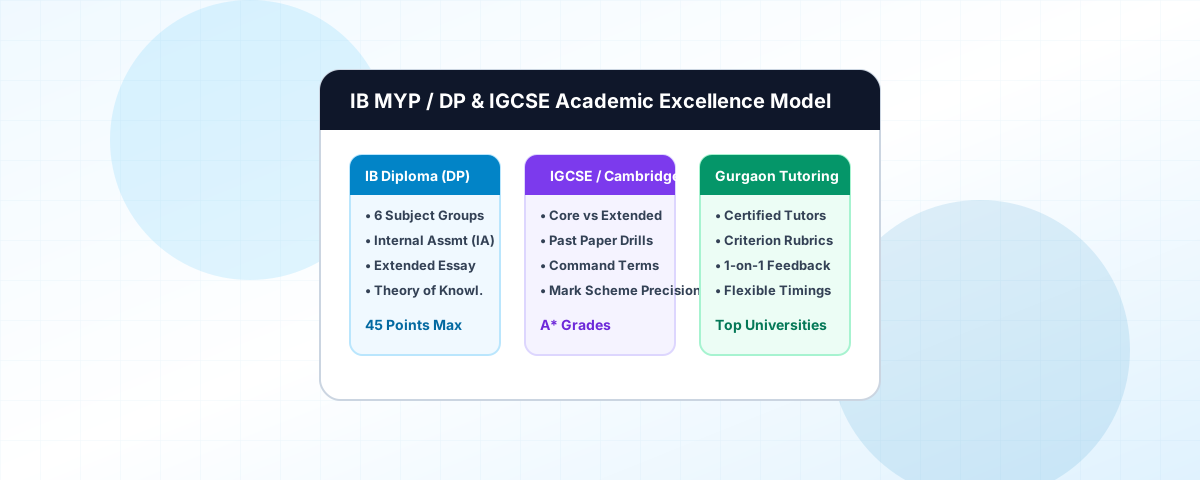
Gurgaon is home to some of India's premier international schools—including The Heritage International Xperiential School, Pathways World School, Lancers International School, GD Goenka World School, and Scottish High. Families choosing the International Baccalaureate (IB) or Cambridge IGCSE curriculum seek a global, inquiry-driven education designed to foster critical thinking, research independence, and seamless admission to top global universities.
However, parents transitioning from traditional Indian boards (CBSE/ICSE) to IB or IGCSE often encounter a steep learning curve. Concepts like Internal Assessments (IAs), Theory of Knowledge (TOK), Extended Essays (EE), Criterion-Based Rubrics, and Cambridge Command Words operate under completely different rules than standard textbook memorization.
This comprehensive guide breaks down the IB and IGCSE academic structures, explaining how Gurgaon parents can effectively support their children and leverage specialized 1-on-1 international board home tuition.
1. Demystifying the IB Diploma Programme (DP) Structure
The IB Diploma Programme (Classes 11 and 12) is a rigorous 2-year pre-university framework evaluated out of 45 total points:
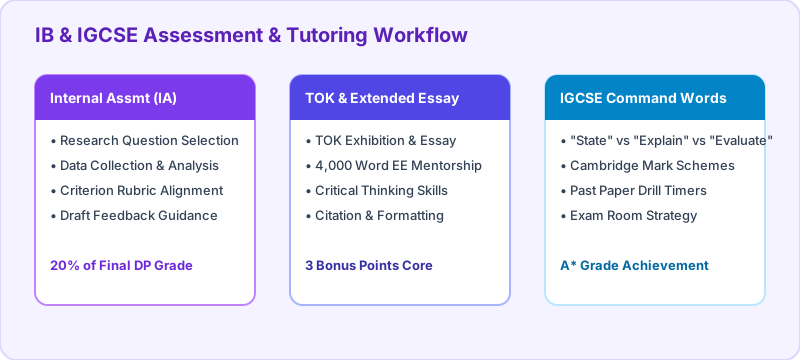
The IB Point Allocation Breakdown:
- 6 Subject Groups (42 Points Max): Students select 3 subjects at Higher Level (HL - 240 hours) and 3 at Standard Level (SL - 150 hours) across Languages, Humanities, Sciences, Mathematics, and the Arts. Each subject is graded from 1 (lowest) to 7 (highest).
- The IB Core (3 Bonus Points Max):
- Theory of Knowledge (TOK): Evaluates how knowledge is constructed across disciplines through an exhibition and a 1,600-word essay.
- Extended Essay (EE): An independent 4,000-word academic research paper on a topic of the student's choice.
- Creativity, Activity, Service (CAS): Mandatory experiential projects fostering community engagement and personal growth.
2. Master the IB Internal Assessment (IA) Requirements
Unlike traditional boards evaluated solely through end-of-year written exams, 20% to 20% of every IB DP subject grade is determined by Internal Assessments (IAs)—individual research papers, lab investigations, or commentary portfolios completed during Class 11 and 12.
| IB DP Subject | IA Requirement | Critical Success Factors |
|---|---|---|
| IB Mathematics (AA / AI) | Mathematical Exploration | Personal engagement, mathematical rigor, clear formatting & reflection |
| IB Physics / Chemistry / Bio | Individual Lab Investigation | Original research question, error analysis, precise data collection |
| IB Economics | 3 News Article Commentaries | Applying economic diagrams & real-world evaluation to current events |
| IB History / Global Politics | Historical Investigation / Engagement | Source evaluation, historiography, balanced critical analysis |
Working with an experienced IB home tutor ensures students structure their research questions, format data tables correctly, and align draft submissions with official IB criterion rubrics.
3. Navigating Cambridge IGCSE (Classes 9 and 10)
The Cambridge IGCSE curriculum provides a flexible foundation for 14-to-16-year-olds. To excel in IGCSE board examinations, students must master Cambridge Command Words:
"In IGCSE marking schemes, answering 'State' requires a single factual phrase; 'Explain' demands a cause-and-effect reason; while 'Evaluate' requires weighing pros, cons, and providing a justified conclusion. Using the wrong response structure results in lost marks even if the underlying science is correct."
Key IGCSE Exam Preparation Rules:
- Differentiate Core vs Extended Tiers: Ensure your child is registered for Extended papers if targeting A* or A grades in Mathematics and Sciences.
- Drill Past Paper Mark Schemes: Cambridge examiners follow strict mark scheme keywords. Practicing past papers alongside mark schemes is essential for score maximization.
- Master Practical Papers (Paper 6 / Alternative to Practical): Understand experimental procedures, safety precautions, graph drawing, and source-of-error identifications.
Specialized support from an IGCSE home tutor helps students practice past-paper command words under strict timed conditions.
4. Why International Board Students Thrive with 1-on-1 Home Tuition
International board students face tight deadlines across IAs, TOK essays, CAS logs, and past-paper drills. Large school classrooms cannot always offer individual feedback on draft essays or specific lab data collection.
Key Benefits of Specialized IB & IGCSE Home Tuition:
- Criterion Rubric Alignment: Tutors break down complex 1-to-7 criterion rubrics so students understand exactly what examiners look for.
- Draft Mentorship: Provides constructive feedback on IA research questions, mathematical explorations, and essay structures before final school submission.
- Past Paper Speed & Precision: Trains students to solve Paper 1, Paper 2, and Paper 3 questions under realistic timed conditions.
Frequently asked questions
How early should an IB DP student start working on their Internal Assessments (IAs)?
IA topic selection and research design should begin early in Class 11 (around October/November). Drafting should take place during Class 11 term breaks so that final revisions do not overlap with Class 12 mock exams.
What is the difference between IB Math AA (Analysis & Approaches) and IB Math AI (Applications & Interpretation)?
Math AA focuses on abstract mathematical proof, algebraic rigor, and calculus—ideal for students aiming for Engineering, Physics, or Computer Science. Math AI focuses on practical applications, statistics, modeling, and financial mathematics—ideal for Business, Economics, or Humanities majors.
Can an IGCSE student switch to IB Diploma in Class 11?
Yes! Cambridge IGCSE provides one of the best foundational preparations for the IB Diploma Programme, as both boards emphasize critical thinking, practical application, and skill-based learning.
How does a home tutor assist IB and IGCSE students in Gurgaon?
Home tutors specializing in international curricula help students choose IA topics, guide research formatting, explain complex criteria rubrics, drill past-paper command words, and assist with subjects like IB Physics, Chemistry, Economics, and Mathematics.