Subject Strategy
How to Overcome Maths Anxiety & Score 95+ in Class 9 & 10 Maths: A Comprehensive Strategy
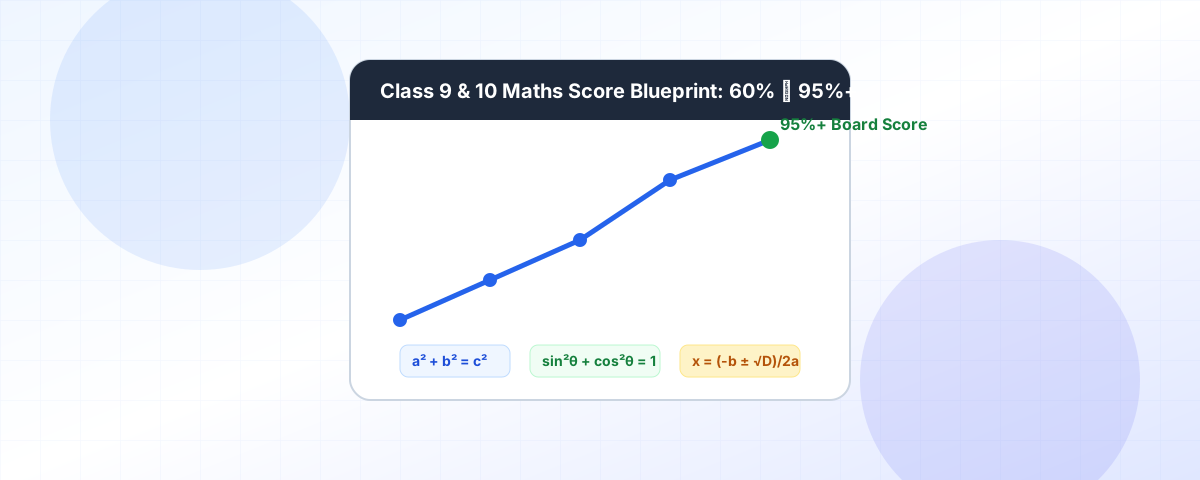
Mathematics is widely considered one of the most scoring subjects in Class 9 and Class 10 CBSE/ICSE curricula—yet it remains a primary source of academic stress for thousands of students across Gurgaon. For many, a single low mark on a unit test can trigger "Maths anxiety," creating a cycle of hesitation, avoidance, and further score drops.
The truth is that Maths is not an innate talent; it is a trainable mechanical skill. Students who achieve 95%+ in Class 10 board exams do not possess a "special math brain"—they follow a structured problem-solving system, maintain an error log, and practice regularly with targeted feedback.
This comprehensive guide breaks down how Class 9 and 10 students in Gurgaon can conquer math anxiety, eliminate silly calculation slips, and master the board exam pattern step-by-step.
1. The 95+ Score Framework for Class 9 & 10 Mathematics
To transform average math performance into board excellence, follow this 3-pillar framework:
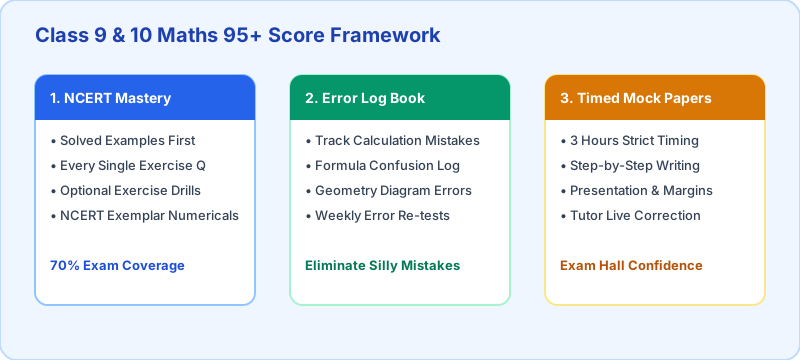
Pillar 1: Total NCERT & Solved Example Mastery
- Never Skip Solved Examples: Over 40% of CBSE board math questions are taken directly from solved examples in NCERT textbooks.
- Do Not Read Math—Write It Out: Reading through math solutions passively creates false confidence. Always solve every problem on paper from start to finish.
- NCERT Exemplar Integration: For Class 10 students targeting 95+, solving NCERT Exemplar numericals is mandatory for higher-order thinking skill (HOTS) questions.
Pillar 2: The Error Log System (Eliminating Silly Mistakes)
Losing 5 to 10 marks per paper due to "silly calculation slips" is the most common reason capable students miss out on top grades. Maintain an Error Log Notebook categorized into three distinct error types:
- Calculation & Sign Slips: (e.g., misplacing minus signs during algebraic expansion or multiplication slips).
- Formula Misapplication: (e.g., confusing surface area formulas for cones vs. cylinders).
- Question Misreading: (e.g., finding radius instead of diameter, or ignoring units).
By reviewing the Error Log weekly, students train their minds to avoid repeating the exact same slip during exams.
Pillar 3: Timed Mock Papers & Presentation Drills
- Master Board Presentation: Show clear step-by-step working, state relevant geometric theorems explicitly in brackets, and box the final answer with S.I. units.
- Strict 3-Hour Timed Testing: Complete at least 8 to 10 full-length sample papers under timed conditions prior to board exams.
2. Chapter-Wise High-Yield Strategy for Class 10 Boards
Certain chapters carry massive weightage in CBSE Class 10 board examinations. Prioritize study hours accordingly:
| Mathematics Unit | Key Topics | High-Yield Board Question Types |
|---|---|---|
| Algebra (20 Marks) | Polynomials, Quadratic Equations, Arithmetic Progressions (AP) | AP word problems, quadratic real-life applications |
| Geometry (15 Marks) | Triangles, Circles | Thales Theorem (BPT) proof, Tangent proofs |
| Trigonometry (12 Marks) | Trigonometric Identities, Heights & Distances | Multi-step identity proofs, 2-observer height problems |
| Mensuration (10 Marks) | Surface Areas & Volumes | Combination of solids (cone + hemisphere), conversion of shapes |
| Statistics & Prob. (11 Marks) | Mean, Median, Mode, Basic Probability | Missing frequency problems, Ogive curves / step-deviation |
A specialized maths tutor in Gurgaon helps students master high-yield theorem proofs and complex word problems with personalized 1-on-1 guidance.
3. How Home Tuition Overcomes Math Anxiety
Math anxiety usually stems from falling behind on foundational prerequisites (such as algebraic factorization or fraction operations) from earlier classes. In large classroom environments, students often hesitate to ask basic doubts for fear of peer judgment.
"A dedicated 1-on-1 home tutor provides a judgment-free environment. By breaking complex multi-step problems into digestible building blocks, a tutor rebuilds mathematical confidence step-by-step."
Key Benefits of 1-on-1 Math Home Tuition:
- Instant Step Correction: The tutor observes the exact step where a student stumbles during problem-solving.
- Customized Speed Drills: Tailors practice sets to individual learning speeds, building mental calculation speed.
- Doubt Resolution without Pressure: Students can ask foundational questions freely until absolute clarity is reached.
4. Parent Action Items: Building a Positive Math Environment at Home
Parents play a pivotal role in shaping a child's mathematical mindset:
- Avoid Labeling Your Child: Refrain from saying "I was weak at math, so my child is too." Mathematical competence is developed through practice, not genetics.
- Encourage Daily 45-Minute Practice: Math requires daily muscle memory. Short, consistent daily practice sessions yield better results than weekend cramming.
- Focus on Process Over Marks: Celebrate the effort and system followed rather than stressing solely over single test marks.
Frequently asked questions
How can a Class 10 student improve math marks from 60% to 90%+ in 3 months?
Start by completing 100% of NCERT textbook exercises and solved examples. Maintain a dedicated Error Log Book to record every calculation mistake made during practice. Finally, work through the previous 10 years' CBSE board papers under timed 3-hour exam conditions with a specialized home tutor.
Is RS Aggarwal or RD Sharma necessary for CBSE Class 10 Maths?
NCERT and NCERT Exemplar form the absolute core for 85–90% of the exam. RD Sharma or RS Aggarwal are helpful for extra practice on complex algebra and trigonometry, but they should never replace thorough NCERT mastery.
What causes "silly mistakes" in Maths exams, and how can they be stopped?
Silly mistakes happen due to rushed handwriting, lack of step-by-step scratchwork, or mental fatigue. Writing out every intermediate step clearly and reviewing answer sheets 15 minutes before the end of the exam drastically reduces these slips.
How does a home tutor help with Class 9 & 10 Maths?
A 1-on-1 home tutor provides personalized instruction, corrects calculation slips line-by-line, explains complex theorem proofs, enforces regular timed testing, and adapts the learning pace to the student's needs.