Entrance Exams
CUET UG Preparation Guide for Gurgaon Students: Master Class 12 Boards & CUET Together

The Common University Entrance Test (CUET UG), conducted by the National Testing Agency (NTA), has transformed undergraduate admissions across India. For Class 12 students in Gurgaon aiming for top colleges at Delhi University (DU), Jawaharlal Nehru University (JNU), Jamia Millia Islamia, BHU, or Dr. B.R. Ambedkar University, CUET scores are now the single deciding factor for admission into coveted programs like B.A. (Hons) Economics, B.Com (Hons), B.Sc (Hons), and BBA/BMS.
With over 14 lakh applicants competing nationwide, achieving a 99+ percentile requires more than just passive reading of Class 12 textbooks. Students must master speed-accuracy trade-offs, negative marking management, and NTA's computer-based test (CBT) format—all while maintaining high scores in their Class 12 CBSE or ICSE board examinations.
1. Decoding the CUET UG Exam Structure
Understanding the three core sections of CUET UG is the first step toward building an effective study plan:
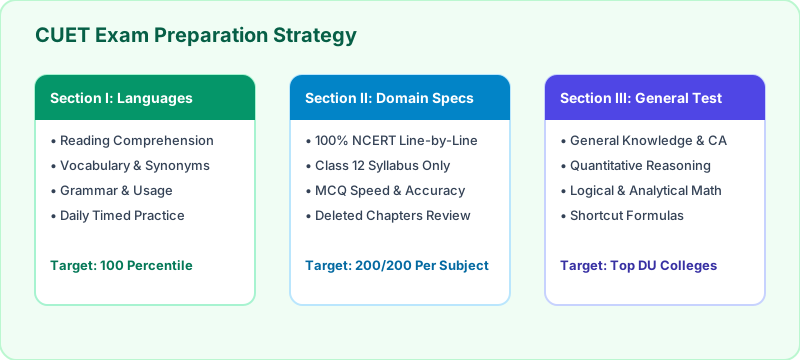
Section I: Language Test (Section 1A & 1B)
- Objective: Tests reading comprehension, vocabulary, synonyms/antonyms, idioms, and verbal ability.
- Popular Choice: English (101) is chosen by over 90% of Gurgaon applicants.
- Format: 40 questions to be attempted out of 50 in 45 minutes.
Section II: Domain-Specific Subjects
- Objective: Tests core subject knowledge based strictly on the Class 12 NCERT syllabus.
- Subject Options: 27 domain subjects ranging from Physics, Chemistry, and Mathematics to Accountancy, Economics, Business Studies, History, and Political Science.
- Format: 40 questions to be attempted out of 50 (or 50 out of 60 for subjects with numerical calculations like Accountancy, Physics, and Maths) in 45 to 60 minutes per paper.
Section III: General Test (GT)
- Objective: Evaluates General Knowledge, Current Affairs, Mental Ability, Numerical Ability, and Quantitative/Logical Reasoning (up to Grade 8 mathematics level).
- Format: 50 questions to be attempted out of 60 in 60 minutes.
- Requirement: Mandatory for courses like BBA, BMS, B.A. Program, and Journalism at DU and other premier universities.
2. Dual Preparation Strategy: Balancing Class 12 Boards & CUET UG
One of the biggest challenges Gurgaon students face is managing dual prep: CBSE/ICSE board exams require long, structured, step-by-step descriptive answers, while CUET UG demands rapid-fire multiple-choice problem solving.
| Parameter | Class 12 Board Exams | CUET UG Entrance Exam |
|---|---|---|
| Exam Format | Offline Pen & Paper (Descriptive) | Computer Based Test - CBT (Objective MCQs) |
| Evaluation Focus | Step-by-step working, diagrams, presentation | Final correct option, speed & accuracy |
| Syllabus Coverage | Prescribed Board Syllabus (Rationalized) | 100% Class 12 NCERT (Including deleted topics) |
| Scoring Pattern | Percentage (%) System | Normalized Percentile Score |
| Negative Marking | None | +5 for Correct, -1 for Incorrect |
The Integrated "Single-Study" Framework:
- Master NCERT Line-by-Line: Since CUET domain questions are taken directly from NCERT textbook sentences, tables, and footnotes, studying NCERT for boards simultaneously builds your CUET domain foundation.
- Track "Board-Deleted" Chapters: CBSE frequently rationalizes or deletes specific chapters from board exams. However, CUET often includes these chapters! Identify deleted units early so you can cover them with a dedicated CUET home tutor.
- Practice Timed MCQ Drills Weekly: Dedicate Saturdays or Sundays exclusively to speed-solving 50-question MCQ sets to get comfortable with the -1 negative marking penalty.
3. Domain-Wise Preparation Tactics
Commerce Stream (Accountancy, Economics, Business Studies)
- Accountancy: Focus heavily on Partnership Accounting, Company Accounts (Shares & Debentures), and Financial Statement Analysis. Practice rapid ratio calculations without relying on calculators.
- Economics: Microeconomics and Macroeconomics demand total clarity on formulas (GDP, National Income, Multiplier) and demand-supply curve shifts.
- Business Studies: Read NCERT case studies carefully; CUET tests subtle distinctions between management principles, staffing steps, and marketing mix components.
Science Stream (Physics, Chemistry, Mathematics, Biology)
- Physics: Formula memory is critical. Create a unit-wise formula chart for Electrostatics, Magnetism, Optics, and Modern Physics.
- Chemistry: Organic Chemistry mechanisms and named reactions account for a significant portion of questions. Memorize Inorganic NCERT periodic tables and trends.
- Mathematics: Speed is the biggest challenge in Maths. Practice shortcut methods for Matrices, Determinants, Integration, and Probability with a specialized maths tutor in Gurgaon.
Humanities Stream (History, Political Science, Psychology, Sociology)
- History & Political Science: Focus on timelines, dates, box items, treaty names, and cartoon-based questions from NCERT.
- Psychology: Pay close attention to psychological terminology, disorder classifications, and assessment definitions.
4. Mastering Section III: The General Test (GT)
Many students lose easy percentile points in the General Test because they underestimate basic quantitative and logical reasoning modules:
- Quantitative Aptitude: Revise Grade 6–8 foundation math: Ratios, Percentages, Profit & Loss, Simple/Compound Interest, Speed-Distance-Time, and Work-Time.
- Logical Reasoning: Solve daily puzzles covering Coding-Decoding, Blood Relations, Syllogisms, Series Completion, and Seating Arrangements.
- Current Affairs & GK: Read national headlines daily and maintain a monthly summary of major government awards, summits, sports achievements, and international appointments.
5. How Normalization Works & Why Percentile Matters
CUET UG is conducted across multiple shifts and days. Because test difficulty varies slightly across shifts, NTA applies an Equipercentile Normalization Method to ensure fair evaluation:
- Your raw score (e.g., 185/200) is converted into a normalized score based on the performance of all candidates who appeared in your specific shift.
- DU cut-offs for top colleges (SRCC, Hindu, Hansraj, LSR, Miranda House) are based on the sum of normalized scores across required domain combinations.
- A score of 790/800+ is often needed for top-tier DU courses, leaving zero margin for unforced errors or careless negative marks.
Frequently asked questions
Is CUET UG mandatory for admission to Delhi University (DU)?
Yes. Admissions to all undergraduate programs at Delhi University (DU) are conducted strictly through CUET UG scores via the CSAS (Common Seat Allocation System) portal. Class 12 board marks are used only as a tie-breaker.
Does CUET include Class 11 syllabus?
No. CUET UG domain subject questions are based exclusively on the Class 12 NCERT syllabus. However, strong Class 11 foundational concepts (especially in Physics, Chemistry, and Mathematics) make learning Class 12 topics significantly easier.
What is the penalty for incorrect answers in CUET?
CUET follows a marking scheme of +5 marks for every correct answer and a penalty of -1 mark for every incorrect answer. Unanswered questions carry 0 marks. Blind guessing should be avoided.
How can a home tutor assist in CUET preparation?
A home tutor provides tailored 1-on-1 instruction, helps students balance board exams with objective MCQ speed-solving, fills conceptual gaps in NCERT topics, and conducts mock test reviews to minimize negative marking.