Board Comparison
CBSE vs ICSE vs IB vs IGCSE: Which Board is Best for Your Child in Gurgaon?
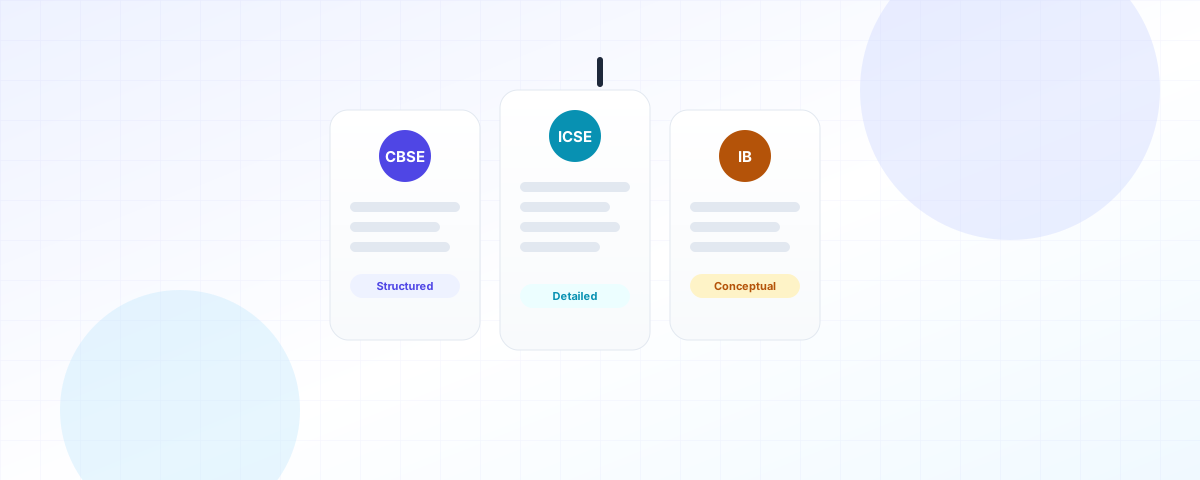
Choosing the right educational board for your child is one of the most critical decisions a parent makes in Gurgaon. With leading international schools, national public schools, and premier private institutions coexisting across DLF, Golf Course Road, and Sohna Road, parents face an array of choices: CBSE, ICSE (CISCE), IB (International Baccalaureate), and Cambridge IGCSE.
Each board features a distinct philosophy, pedagogical approach, assessment structure, and alignment with higher education goals. Whether your target is an IIT/NEET medical seat in India or admission to top Ivy League or Russell Group universities abroad, selecting the right academic environment—and complementing it with specialized home tuition—is key to your child's success.
1. Executive Summary & Comparison Matrix
Before diving into detailed board breakdowns, evaluate how the four major boards compare across core parameters:
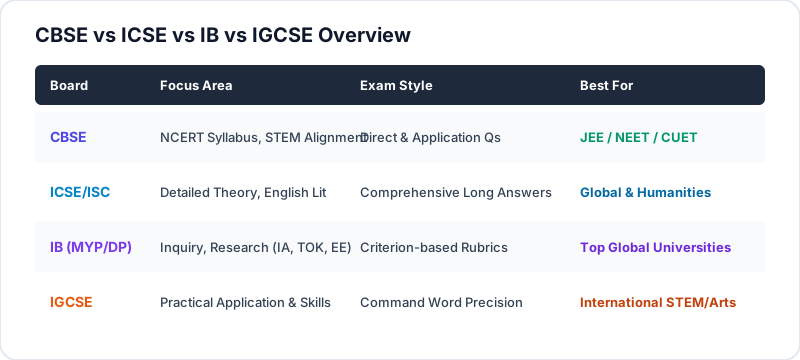
| Parameter | CBSE | ICSE / ISC | IB (MYP / DP) | IGCSE (Cambridge) |
|---|---|---|---|---|
| Governing Body | Central Board of Secondary Education (India) | Council for the Indian School Certificate Examinations | International Baccalaureate (Geneva, Switzerland) | Cambridge Assessment International Education (UK) |
| Syllabus Focus | Mathematics, Science & National Competitive Exams | Comprehensive English Literature, Science & Humanities | Inquiry-based, Research, Critical Thinking & Writing | Practical Application, Skills & Subject Choice Flexibility |
| Assessment Model | Year-end Board Exams + Internal Assessments | Year-end Board Exams + Detailed Practicals | Internal Assessments (IA), TOK, Extended Essay & Final Exams | Component-based Papers (Core vs Extended) & Coursework |
| Ideal For | Students aiming for JEE, NEET, CUET & Indian Universities | Students seeking strong English, Literature & Balanced Arts/STEM | Students targeting Ivy League, UK & Global Higher Education | Students preferring flexible international qualifications |
2. CBSE (Central Board of Secondary Education)
Philosophy & Curriculum Focus
CBSE is India’s largest national board, operating under the Union Government. Its curriculum is structured around the National Curriculum Framework (NCF) and relies heavily on standard NCERT textbooks.
Key Strengths:
- Direct Alignment with Entrance Exams: The syllabi for national competitive exams like JEE (Main & Advanced), NEET UG, and CUET are based on the CBSE Class 11 and 12 curriculum.
- National Uniformity & Transferability: Ideal for families who relocate within India, as CBSE schools follow a standardized textbook structure across all cities.
- Clear Marking Scheme: Exam patterns emphasize direct conceptual questions, formula application, and prescribed answer structures.
Challenges:
- Less emphasis on creative writing, deep literary analysis, and independent research compared to international or ICSE boards.
- Large class sizes in popular Gurgaon schools can make it difficult for students to receive personalized attention in complex subjects like maths or chemistry.
3. ICSE / ISC (Council for the Indian School Certificate Examinations)
Philosophy & Curriculum Focus
ICSE (Class 10) and ISC (Class 12) are recognized for their rigorous, detailed, and expansive curriculum. The board places a strong emphasis on English language proficiency, literature, humanities, and detailed science practicals.
Key Strengths:
- Exceptional Language & Communication Base: The comprehensive English curriculum builds strong vocabulary, grammar, and essay-writing skills early on.
- Balanced Knowledge Across Streams: Students study a broader range of subjects through Class 10, developing equal competence in sciences and social sciences.
- Global Recognition: Recognized by international universities due to its academic rigor and comprehensive evaluation standards.
Challenges:
- High Syllabus Volume: The sheer quantity of chapters and detailed answers can feel overwhelming during exam preparation.
- Competitive Exam Transition: Students targeting JEE or NEET must adapt to the fast-paced, objective MCQ format, which differs from ICSE's descriptive exam style. A dedicated ICSE home tutor helps bridge this gap effectively.
4. IB (International Baccalaureate — MYP & DP)
Philosophy & Curriculum Focus
Headquartered in Geneva, the IB program (Middle Years Programme for Class 6–10, Diploma Programme for Class 11–12) is an inquiry-driven, research-focused international curriculum designed to develop independent critical thinkers.
Key Strengths:
- Holistic & Application-Based Learning: IB moves away from rote learning, focusing on conceptual understanding, global contexts, and real-world application.
- The IB Core (DP): The Diploma Programme includes three mandatory core components that prepare students for university-level research:
- Theory of Knowledge (TOK): Explores how we know what we know.
- Extended Essay (EE): An independent 4,000-word research paper.
- Creativity, Activity, Service (CAS): Encourages experiential learning outside the classroom.
- Unrivalled Global University Preference: Top global institutions actively seek IB DP graduates for their advanced essay-writing, analytical skills, and research experience.
Challenges:
- High workload demands exceptional time-management skills. Students often require guidance on Internal Assessments (IA) and criterion-based grading rubrics from an experienced IB home tutor.
5. Cambridge IGCSE (International General Certificate of Secondary Education)
Philosophy & Curriculum Focus
Administered by Cambridge Assessment International Education, IGCSE is the world's most popular international qualification for 14-to-16-year-olds (equivalent to Class 9 and 10), leading seamlessly to Cambridge International AS & A Levels.
Key Strengths:
- Subject Choice Flexibility: Offers over 70 subjects, allowing students to combine sciences, humanities, languages, and creative disciplines according to their strengths.
- Differentiated Tiering (Core vs Extended): Students can choose between Core papers (foundational content) and Extended papers (advanced content targeting top grades A*–C).
- Skill-Based Assessment: Evaluates practical skills, problem-solving, and precise application using strict examiner command words ("Explain", "Discuss", "Evaluate").
Challenges:
- Requires familiarity with Cambridge mark schemes and past-paper patterns. Specialized support from an IGCSE home tutor ensures students master precise command-word responses.
6. How to Choose: Decision Framework for Gurgaon Parents
When deciding between CBSE, ICSE, IB, or IGCSE, evaluate your family's primary academic goals:
-
If your child aims for Engineering (JEE) or Medical (NEET) in India:
- Recommended Board: CBSE
- Why: Direct alignment with NTA entrance exam syllabi minimizes double preparation.
-
If you want a strong academic foundation with top English & Humanities:
- Recommended Board: ICSE / ISC
- Why: Offers deep subject coverage and excellent language grounding for law, management, or humanities.
-
If your goal is admission to premier Universities in the US, UK, or Europe:
- Recommended Board: IB DP or Cambridge A Levels
- Why: Recognized worldwide for fostering research skills, critical analysis, and self-directed study.
Frequently asked questions
Can an IB or IGCSE student clear Indian competitive exams like JEE, NEET, or CUET?
Yes, but it requires strategic alignment. While science concepts are similar across boards, IB/IGCSE focus on analytical essays and practical experiments, whereas Indian entrance exams focus on fast-paced objective MCQs. Supplementary coaching or a specialized home tutor is highly recommended to bridge this gap.
Is ICSE tougher than CBSE?
ICSE covers a broader syllabus volume with more detailed descriptive topics in early classes, especially in English and Social Sciences. CBSE focuses heavily on core Science and Mathematics aligned with national entrance standards. Neither is objectively "tougher"; they simply prioritize different skills.
What is the difference between IB HL and SL subjects?
In the IB Diploma Programme, Higher Level (HL) subjects involve 240 teaching hours and explore topics in greater depth, whereas Standard Level (SL) subjects involve 150 hours. Students choose 3 HL and 3 SL subjects based on their intended university major.
How does a home tutor help international board (IB / IGCSE) students?
Home tutors experienced in IB and IGCSE provide essential guidance on Internal Assessments (IAs), lab reports, criterion-based rubrics, Extended Essay structuring, and past-paper command-word techniques tailored to individual learning styles.