Exam Prep
CBSE Board Exam Preparation: A Comprehensive Home Tuition Guide for Parents

CBSE board exams represent a crucial milestone for students in Gurgaon. For Class 10 students, the results dictate stream selection—whether entering Science (PCM/PCB), Commerce, or Humanities. For Class 12 students, board percentages significantly influence university admissions, CUET cut-offs, and competitive foundation confidence. Yet, despite studying long hours, many capable students struggle to achieve their target scores because they lack a systematic, strategic approach to the CBSE exam format.
Top-scoring students rarely succeed by relying on cramming or last-minute revision. Instead, they follow a disciplined study framework, master answer-presentation techniques, and utilize expert guidance to eliminate conceptual gaps early. This ultimate guide brings together proven CBSE board exam preparation strategies refined by senior educators and home tutors across Gurgaon.
1. Establishing a Structured 6-Month Preparation Plan
Consistency is the single biggest predictor of CBSE board exam success. Scrambling in the final weeks creates cognitive fatigue and leads to preventable mistakes during exams. A well-structured preparation plan distributes syllabus coverage evenly across the academic year.
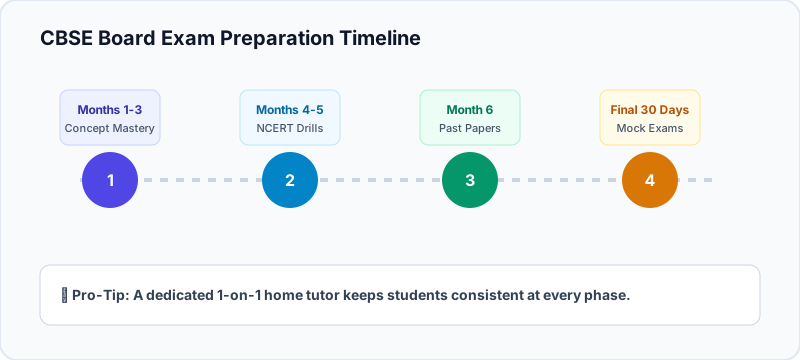
Phase 1: Conceptual Foundation & NCERT Deep Dive (Months 1–3)
During this phase, focus on completing the entire syllabus with thorough conceptual understanding:
- Prioritize NCERT Textbooks: CBSE exam papers are derived directly from NCERT line-by-line concepts, definitions, and solved examples.
- Maintain Subject Notebooks: Maintain separate formula sheets for Physics and Mathematics, and reaction mechanisms for Chemistry.
- Weekly Progress Benchmarks: Aim to cover 2–3 chapters per subject weekly, verifying retention through end-of-chapter exercises.
Phase 2: Targeted Drills & Chapter-wise Testing (Months 4–5)
Once the syllabus is covered, transition from passive reading to active testing:
- Solve NCERT Exemplar Problems: Essential for Class 10 and 12 Science and Maths, as higher-order thinking skill (HOTS) questions are frequently adapted from Exemplar books.
- Target Weak Areas: Identify chapters where accuracy drops below 80% and schedule targeted revision sessions with a specialized CBSE home tutor.
Phase 3 & 4: Full-Length Past Papers & Timed Mocks (Final 30–45 Days)
Simulate realistic exam hall conditions by solving previous 10 years' CBSE board papers:
- Strict 3-Hour Timed Environment: Start at 10:30 AM (matching official CBSE exam timings) to train your brain for peak mental alertness during exam hours.
- Evaluate Against Marking Schemes: Grade your answers strictly using official CBSE marking schemes to understand step-marking criteria.
2. Deciphering the CBSE Syllabus Weightage & Marking Scheme
Understanding how marks are distributed across units enables students to allocate study time efficiently. Spending days on a 3-mark topic while neglecting a 10-mark chapter is a common pitfall.
| Subject | High-Weightage Units | Key Preparation Focus |
|---|---|---|
| Class 10 Maths | Algebra (20 Marks), Geometry (15 Marks), Trigonometry (12 Marks) | Theorem proofs, step-by-step working, NCERT examples |
| Class 10 Science | Chemical Substances (25 Marks), World of Living (25 Marks), Natural Phenomena | Labeled ray diagrams, chemical equations, numericals |
| Class 12 Physics | Electrostatics & Current (16 Marks), Optics (18 Marks), Modern Physics | Derivations, circuit diagrams, conceptual reasoning |
| Class 12 Chemistry | Organic Chemistry (33 Marks), Physical Chemistry (23 Marks) | Named reactions, numerical units, conversion pathways |
A specialized Class 10 home tutor or Class 12 home tutor helps students navigate unit weightages, ensuring high-yield chapters receive maximum practice.
3. Answer-Writing Mechanics: Turning Knowledge into Full Marks
Knowing an answer and presenting it to earn maximum credit from a CBSE examiner are two distinct skills. Examiners grade hundreds of answer sheets daily and reward clean, structured, and legible responses.
"CBSE examiners assign marks per step. Missing units in physics numericals, omitted arrows in ray diagrams, or paragraph-style answers in biology frequently result in lost marks even when the concept is correct."
Key Presentation Rules for CBSE Boards:
- Use Bullet Points for Theoretical Answers: Break long answers into distinct numbered points with key terms highlighted or underlined.
- Mandatory Diagrams & Graphing: Draw neat, pencil-drawn diagrams with clear labels for Biology and Physics questions.
- Show Step-by-Step Mathematical Calculations: Always write down the given data, formula used, step-by-step substitution, and final answer with proper S.I. units.
- Adhere to Word Limits: Respect the prescribed word limits (e.g., 30–50 words for 2-mark questions; 80–120 words for 5-mark questions) to conserve time for complex sections.
4. Subject-Wise CBSE Preparation Blueprints
Mathematics & Physics
- Formula Flashcards: Review key formulas and identities daily.
- Avoid Mental Calculations: Always complete rough calculations in the designated margin on the answer sheet to prevent arithmetic slips.
- Dedicated support from a expert maths tutor in Gurgaon or physics tutor ensures instant error correction on complex numericals.
Chemistry & Biology
- Organic Chemistry Flowcharts: Create visual reaction maps linking alcohols, aldehydes, ketones, and carboxylic acids.
- NCERT Biology Diagrams: Practise drawing diagrams like the human heart, nephron, plant reproductive structures, and DNA replication forks until speed and accuracy become second nature.
English & Social Science
- Format Precision: Memorize exact layouts for formal letters, analytical paragraphs, reports, and notices.
- Map Work Accuracy: Secure full marks in Social Science by practicing map locations for history events and geography resources weekly.
5. Overcoming Exam Nerves & Building Peak Stamina
Mental resilience and physical well-being directly impact academic performance during board season:
- Maintain 7–8 Hours of Sleep: Sleep consolidation is critical for memory retrieval. Depriving the brain of rest before an exam impairs recall speed.
- Take 10-Minute Micro-Breaks: Follow the Pomodoro technique (50 minutes of intense study followed by a 10-minute break) to maintain sharp concentration.
- Positive Parent-Student Dynamics: Parents should provide an encouraging home environment free from comparison. One-on-one home tuition creates a calm, supportive space where students can ask questions without hesitation.
Frequently asked questions
When should a student start preparing for CBSE Class 10 & 12 board exams?
Preparation should ideally begin at the start of the academic session in April. Dedicated board-focused revision and past-paper solving should start by October or November to allow ample time for full-length mock tests before February.
How can a home tutor help improve CBSE board exam scores?
A dedicated home tutor provides personalized 1-on-1 instruction, identifies specific learning gaps, enforces regular timed tests, corrects answer presentation flaws line-by-line, and ensures accountability without the distraction of large coaching batches.
Are NCERT textbooks sufficient to score above 90% in CBSE board exams?
Yes, NCERT textbooks form the core foundation for 85–90% of CBSE question papers. However, to tackle higher-order thinking skills (HOTS) and application-based questions, solving NCERT Exemplar problems and previous 10 years' board papers is strongly recommended.
How many sample papers should a student solve before the CBSE board exam?
Students should aim to complete at least 8 to 10 full-length, timed sample papers per subject under strict 3-hour exam conditions. Reviewing mistakes after each paper is essential for continuous score improvement.